Latest AI News

Wirestock raises $23M to supply creative multi-modal data to AI labs
In the past few years, creative marketplaces and platforms have realized that they are sitting on a data goldmine, and they can either use that data to develop AI models themselves or turn it into a source of revenue by licensing it to other AI labs. Wirestock, which previously helped photographers distribute and sell their work on stock photography services like Shutterstock, has taken the latter path. The company pivoted to being a data provider in 2023, and now supplies datasets of images, videos, design assets, and gaming and 3D content to AI labs. Wirestock said its platform has signed up more than 700,000 artists and designers who complete different tasks for data collection, similar to freelancers on platforms like Fiverr. Mikayel Khachatryan, the company’s co-founder and CEO, said Wirestock was transparent about its shift, and allowed artists to opt out of its data supply business (in 2022, the platform had over100,000 photographerson its platform). Khachatryan didn’t specify how many people switched over as data providers for AI, only saying “the majority” did. “Initially, a lot of our deals were just selling what we had off the shelf, like our existing library. But then it turned into a lot of custom requests for content and data, and that created new opportunities for creators, and the platform just took off,” he said. The startup said on Thursday it has raised $23 million in Series A funding to build out the new data supply business. The round was led by Nava Ventures, and saw participation from SBVP (co-founded by Sheryl Sandberg), Formula VC, and I2BF Ventures. Khachatryan says Wirestock currently provides multi-modal data to six of the largest foundation model makers, but he wouldn’t name them. He noted the company currently has an annual run-rate revenue of $40 million and has so far paid out $15 million to its contributors. As part of the transition, the startup had to retrain some of its teams to annotate and label data in detail to make it useful for AI labs. It also had to build sales and enterprise teams to be able to pitch to hyperscalers, and find ways to get more creative assets in areas like 3D modeling. Wirestock currently uses email marketing and referral programs to bring in new contributors. Photographers, videographers, and illustrators can apply to provide data on its website, but they have to complete an unpaid task as a quality check before they're accepted. The company said it uses a mix of AI and human reviews to evaluate all work on the platform. Demand for data supply services is sky high right now as AI labs race to continue improving their models. Companies like Surge, Scale AI, and Mercor have built businesses worth tens of billions seemingly overnight on the back of demand for different kinds of datasets, and a slate of new startups such asMicro1,Human Archive, andHuman Native AIare working with top AI model makers, too. Wirestock wants to focus on providing data for models that aid creative use cases, such as image and video generation. The company is also exploring other modalities like audio and music. Freddie Martignetti, founder of Nava Ventures, said his fund was looking for a startup that was innovating on data procurement and refinement even before it learned about Wirestock. "I think Wirestock has a deep understanding of what foundational models and hyperscalers need in terms of multi-modal data to start creating more human-like systems. The cornerstone of our thesis was that multi-modal data will be increasingly important, not just to create images or videos, but for models to complete real-world tasks," Martignetti told TechCrunch. Wirestock currently employs 60 people, and will use the new funding to hire for research, engineering, and product roles. It is also building enterprise software for AI labs to collaborate on datasets. The funding round brings the startup's total capital raised to about$26 million.
View
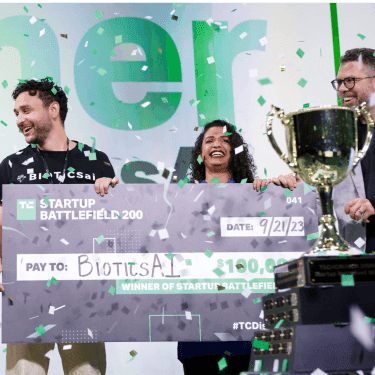
Two weeks left: Startup Battlefield 200 applications close May 27
Your shot at VC access, global visibility, TechCrunch coverage, and $100,000 equity-free funding is running out. Startup Battlefield 200applications officially close in just two weeks. If you’re building a breakout startup — or know a founder who is — now is the time to act. Apply by May 27for the opportunity to take the stage atTechCrunch Disrupt 2026alongside 200 of the world’s most promising early-stage startups. Pre-Series A founders, consider this your countdown reminder: The strongest startups are already entering the arena. If your startup has already been nominated, don’t wait to complete your application. The final stretch moves fast, and late submissions risk getting lost in the noise. Know a startup that deserves the spotlight?Nominate them nowso they still have time to apply before the deadline. Startup Battlefield 200 is where breakout companies get discovered. Selected startups will showcase live at Disrupt 2026 in front of 10,000+ attendees, leading VCs, global media, and the full TechCrunch audience. This is your chance to gain investor exposure, receive direct VC feedback, and prove your company belongs among the next generation of category-defining startups. Early applicants gain an advantage: more time to prepare, more opportunities to stand out with TechCrunch editors, and more momentum before competition intensifies. We’re looking for ambitious early-stage startups building innovative, potentially category-defining products. Applications are open globallyacross all industries. Most selected companies are pre-Series A, though select Series A startups may qualify on a case-by-case basis. To apply, startups should have: This is the same launchpad that helped accelerate companies like Dropbox, Discord, Fitbit, Trello, and Mint. Thousands apply every year. Only 200 are selected. Just 20 finalists pitch live on the Disrupt Stage. One startup takes the crown. Startup Battlefield 200 offers one of the highest-ROI opportunities available to early-stage founders — andit’s free to apply. Selected startups receive: Two weeks. That’s it. The founders who break through aren’t waiting for the final hour — they’re already making their move. If you’re building something category-defining, or know a startup that deserves the spotlight,submit your nomination and complete your application before May 27.
View

Cisco cuts nearly 4,000 jobs to spend more on AI, reports ‘record quarterly revenue’
Technology giant Cisco is cutting fewer than 4,000 jobs, or around 5% of its workforce, despite reportingbetter-than-expected profit and revenuein its fiscal third quarter. The networking equipment maker said it reducing its headcount in order to change its “cost structure” and invest in AI and cybersecurity. Cisco’s decision follows a recent trend of tech companies increasingly citing a priority on AI spending as a reason to let employees go.CloudflareandGeneral Motorshave both laid off staff in recent days, despite reporting strong financial results. Cisco said it plans to invest more in cybersecurity, as the company continues to contend witha slewofsecurity vulnerabilitiesin its routers and firewalls that have allowed hackers to break into the networks of its corporate customers,including the U.S. government. Cisco last year also experienceda data breachin which customers’ personal information was affected. Ina blog postpublished Wednesday, Cisco’s chief executive Chuck Robbins touted the company’s “record revenue” and “double-digit growth,” while acknowledging that the company was making strategic investments “in our employees’ use of AI across the company.” Accordingto public filings, Robbins was slated to earn more than $52 million in executive compensation during 2025. When reached by TechCrunch, a Cisco spokesperson did not comment beyond Robbins’ statement, or say, when asked, if Robbins plans to reduce his compensation. This is the latest round of job cuts at Cisco in recent years. The company laid off thousands of employeesduring two separate layoffs in 2024, andcut 150 jobsin 2025.
View

Khosla Ventures is betting $10M on Ian Crosby, whose first startup, Bench, imploded
Ian Crosby, whose previous startup Bench Accounting famouslyshut down in 2024before beingbought for scraps, is taking another shot at building a business out of automating the arduous work of bookkeeping. His new startup,Synthetic, aims to build a fully autonomous AI bookkeeper that can generate accrual-based financials without direct human involvement. Although the product is still in the design phase — and Crosby admits his vision may not yet be technologically possible — the startup has raised $10 million in a seed funding round led by Khosla Ventures, with participation from Basis Set Ventures and Shopify CEO Tobias Lütke. Most investors would run from a founder facing the kind of challenges Crosby is right now — the fallout of his previous business collapsing and a vision that may exceed the technical feasibility of current foundational models. But Khosla partner Jon Chu told TechCrunch he sometimes does just the opposite: “I tend to run towards controversy a little bit.” “In controversy, groupthink often shapes the narrative rather than the truth of the story itself,” he said, citing Parker Conrad’s 2016 ousting from Zenefits as an example. While the industry narrative was initially critical of Conrad, he subsequently founded Rippling, which is now valued at nearly $17 billion. “I believe people have room for growth,” Chu said about his bet on Crosby and Synthetic. Crosby maintains he wasn’t directly responsible for bringing Bench to the point of insolvency. According to him, he wasfired by Bench’s boardin 2021, three months after he turned down a $250 million acquisition offer from Brex. The board also disagreed with Crosby’s strategic direction, especially as the business was bleeding cash, and his executive team was reportedlyfrustrated with his direct leadership style. “He took a big swing, made a few mistakes. That didn’t go well,” Chu said. Bench ultimately imploded when its new management proved unable to restore the company to health on its own. After leaving Bench, Crosby joined Shopify and founded Teal, another accounting startup, which was bought by Mercury 18 months later. As part of his due diligence, Chu said he spoke with several executives who worked with Crosby after his departure from Bench, and they all “had fantastic things to say about Ian,” Chu told TechCrunch. Chu is convinced that the three roles Crosby held after leaving Bench provided the entrepreneur with ample opportunity to learn from his past mistakes. Crosby says he has his eyes firmly set on creating a fully AI-driven bookkeeping service, rather than relying on human accountants, as most accounting startups such as Xero do now. “We're not going to release anything that's not fully autonomous,” Crosby told TechCrunch. “It’s that or bust.” Synthetic plans to serve only AI and other software startups. But Crosby acknowledges that AI models still make significant bookkeeping mistakes. While Synthetic's prototype works for a narrow group of users, he remains uncertain how it will scale for a broader customer base. Crosby explained with an analogy: “It's like a self-driving car that can drive down one street versus the self-driving car that can drive down any street. We haven't driven down enough streets to know if it's going to crash.” Still, the founder says he can afford to be patient and wait for foundational models to become more reliable for bookkeeping calculations. “I've raised years of cash, so we can just wait it out,” Crosby said.
View

Cerebras raises $5.5B, kicking off 2026’s IPO season with a bang
Cerebras raised $5.5 billion in its IPO on Thursday, pricing shares at $185 Wednesday evening, way higher than its range ($115 to $125, later raised to $150-$160), even as it increased the size of the offering to 30 million shares. And pre-market trading indicates that shares are going to open with a giant pop, as retail investors bid up the price to grab them. (We’ll update this story after trading begins.) Even at the IPO price, the company enters its first day of trading at a fully-diluted valuation of $56.4 billion (meaning, accounting for all shares). Co-founder CEO Andrew Feldman’s stake at $185/share is worth nearly $1.9 billion, while co-founder CTO Sean Lie’s stake weighs in at about $1 billion. A year ago, it looked like this day would never happen for Cerebras. The Nvidia competitor, which designed its giant chip from scratch, purpose-built for AI, had first filed to go public in 2024. But concerns about a large investment from Abu Dhabi-based Group 42 mired the IPO in an endless review from the Committee on Foreign Investment in the United States (CFIUS). Investors were also cool about its financials: Group 42 accounted for almost all of Cerebras’s revenues. So those IPO plans were shelved. IPO ambitions reappeared in earnest in April when the companywas able to report about double the revenues: $510 million in 2025 (up 76% year-over-year), and from a handful of customers. It also reported a massive swing to a profit — to $237.8 million in net income — compared to losing nearly half a billion the year before. Investors began salivating. Cerebras has now come out as a major contender for supplying chips for inference — the ongoing compute processing required for models to answer prompts — and now counts OpenAI (in acomplicated circular-deal relationship), G42, Saudi’s Mohamed bin Zayed University of Artificial Intelligence and Amazon Web Services as customers. Developing, will update this post with first-day of trading numbers.
View

Amazon Kills Rufus AI, Replaces It With Alexa for Shopping AI Assistant
Amazon, on Wednesday, announced Alexa for Shopping, a new artificial intelligence (AI) shopping assistant. The new tool comes with agentic capabilities and replaces Rufus AI, a mainstay on the app and the website since February 2024. The Seattle-based tech giant revealed that the new AI experience combines Rufus AI and Alexa+ to bring an assistant that not only has deep knowledge of Amazon's shopping platform and catalogued products, but also brings the immersive conversational layer with agentic automation. The new tool is first rolling out in the US.
View

AI-Native Startup Exaforce Secures $125 Mn to Scale Agentic Security Operations
Beyond geographic expansion, the company intends to bolster its presence in research and development by enhancing multi-model AI capabilities and aiding enterprises in operationalising agentic workflows.
View

Cisco to Cut Nearly 4,000 Jobs in Q4 Amid AI Shift
The networking company plans workforce cuts while increasing investments in AI, silicon, optics, and security.
View

Fuel Crisis Reopens India’s Most Uncomfortable Workplace Debate
Industry observers say many IT companies remain wary of returning to prolonged remote work, especially as they restructure teams and adapt to AI-led changes in business models.
View

The Traditional E-Commerce Interface is Starting to Collapse
Generative AI is changing how consumers discover products online by turning static recommendations into real-time shopping experiences.
View

Microsoft Edge Update Allows Copilot to Access Open Tabs; Journeys Mode Introduced in English
Microsoft has introduced the Copilot's agentic AI capabilities to the Edge mobile app. Now, users will be able to ask queries to Microsoft's AI agent, which will access information for them from active tabs to generate answers. The company is also rolling out the AI-backed Journeys tool for the Edge mobile app, which will organise the user's browsing history into different topics, allowing users to pick up browsing from where they left off. Microsoft recently redesigned the new tab page for the Edge desktop app. It is now bringing the same design to its mobile browser, where users will be able to directly ask questions to Copilot.
View

Anthropic Introduces Claude for Small Business With Ready-to-Run AI Workflows, Connectors
Anthropic, on Wednesday, announced a new offering for smaller enterprises. Dubbed Claude for Small Business, the new solution brings a set of new connectors and ready-to-run workflows to power artificial intelligence (AI)-powered automation within tools that small businesses use the most. With this release, the San Francisco-based AI startup is also diversifying its product and service offerings to serve different enterprise niches. The announcement comes just a week after the company launched a new business venture to provide AI services to enterprises.
View