Latest AI News

With Indian IT Entry Roles Automated, Freshers Now Need Meta Skills
AI is not just eliminating entry-level IT jobs. It is raising the bar for what a fresher must know to get through the door.
View

AI is Breaking Data Centre Cooling Systems, But to India's Advantage
As AI workloads multiply and power densities soar, data centres are racing to overhaul the cooling infrastructure to keep their operations alive.
View

Apple to Introduce Improved Genmoji, Image Playground Upgrades With iOS 27 Update: Mark Gurman
Apple is believed to preview iOS 27 at its WWDC event in June. The next-generation operating system is expected to offer improved Apple Intelligence features with an enhanced AI-powered image generation experience. A new report by Bloomberg's Mark Gurman suggests that Apple's image generation models used in Genmoji and Image Playground will get notable upgrades in visual quality. The reported improvements are expected to be noticeable in Genmoji and Image Playground. Earlier reports indicated that Apple is working on support for third-party AI image-generation models in iOS 27.
View

Apple Is Reportedly Working on a New Gen AI Website Ahead of WWDC 2026
Ahead of Apple's annual Worldwide Developers Conference (WWDC), a new development has surfaced. As per the report, the Cupertino-based tech giant is readying a new “Gen AI” website, which could be showcased at WWDC 2026. It is currently non-functional and shows a connection timed out error, but the website appears to be registered. This means it could be stopped from going live on the server side. The purpose of the website is not clear immediately, but it indicates that artificial intelligence (AI) could be a major topic in this year's event.
View

Maveric Systems Wants Banks to Walk Away From Flashy AI Pilots
CEO Ranga Reddy says Maveric now rejects AI work unless banks meet three strict readiness conditions.
View

Bihar to Launch Dedicated AI Policy, Aims to Become India’s Next AI Hub
The state is preparing a new AI policy focused on digital infrastructure, innovation and employment generation to accelerate its transformation into an AI-driven economy.
View

HCLTech, Pegasystems Expand AI Partnership to Modernise Legacy Enterprise Systems
HCLTech has expanded its partnership with Pegasystems to help enterprises modernise legacy technology systems using AI, as IT services firms sharpen their focus on AI-led transformation deals.
View

The Voice AI Experience in India Sucks. But Vobiz.ai Has a Plan to Fix it
Vobiz.ai is focused on the telecom infrastructure that carries every AI conversation.
View
Everyone is navigating AI security in real time — even Google
I recently had the opportunity to sit down with Francis de Souza, COO of Google Cloud, backstage at aneventin Los Angeles. Amid the din around us, de Souza, who speaks in the calm, measured manner of a university professor, offered useful advice for companies navigating the AI security moment we’re all living through, noting that “there’ll be a transition period, and then I think we get to this better place.” He wasn’t speaking about Google at that moment, but it’s clear that even Google is still figuring things out. De Souza’s core message was one security professionals have been trying to get executives to internalize for years, now made urgent by AI: security can’t be an afterthought. “As companies embark on this AI journey, they need to take a platform approach,” he said. “Security is not something you can bolt on later, and it’s not something you can leave up to employees to do on their own.” He warned specifically about “shadow AI” — employees reaching for consumer tools without organizational oversight — and argued that companies need to demand security, governance, and auditability from their platforms from the start. “There’s no such thing as an AI strategy without a data strategy and a security strategy. They need to go hand in hand.” Worth noting: he wasn’t pitching Google Cloud alone. When I observed that his advice sounded like a Google advertisement, he pushed back. Google, he said, is committed to a multicloud approach, and he made the case that companies that think they’re operating on a single cloud almost certainly aren’t. “Even if they pick a single cloud, they’re relying on SaaS applications, there are business partners that may be using different clouds,” he said. “It’s important for companies to have a security posture that is consistent across clouds, across models.” He also made the case that the threat landscape has changed so fundamentally that old defensive models are too slow. He noted that the average time between an initial breach and the handoff to the next stage of an attack has dropped from eight hours to 22 seconds, and that the attack surface has expanded well beyond the traditional network perimeter. “In addition to your usual estate, you have models now. You have data pipelines used to train the models. You have agents, you have prompts. All of this needs to be protected.” One threat de Souza flagged that doesn’t get enough attention: agents moving through a company’s internal systems can surface forgotten data repositories that nobody has thought about in years. “A lot of organizations have old SharePoint servers [and access controls] they haven’t really updated, but it didn’t matter because nobody really knew where they were. But agents roaming your enterprise will find those data assets and will expose the data on them.” The answer, in his view, is to meet machine speed with machine speed. “We’re now seeing the emergence of an AI-native, fully agentic defense where organizations can run agents driving their defense,” he said. “Instead of having a human-led defense or even a human in the loop, you can now have humans overseeing a fully agentic defense.” He added that this has become a leadership issue, not just a technology one. “This is a board-level issue and an executive team issue. It’s not just a security team’s issue.” But even as AI takes on more of the defensive workload, the people qualified to oversee it are in short supply — and the vulnerabilities that AI itself is introducing are multiplying faster than security teams can address them. “We’re going to need people to deal with the bug-pocalypse,” LinkedIn’s chief information security officer Lea Kissnertold the New York Timesthis week, adding that she doesn’t expect the industry to understand AI security in any sustainable long-term way for at least several years. Which brings us back to the platform providers themselves. The Register has published a series of reports over the past several weeks documenting a wave of Google Cloud developers hit with five-figure bills following unauthorized API calls to Gemini models — services many of them had never used or intentionally enabled. The cases followed a familiar pattern: API keys originally deployed for Google Maps, placed publicly per Google’s own instructions, had quietly become capable of accessing Gemini after Google expanded their scope without clearly disclosing the change. Rod Danan, CEO of interview-prep platform Prentus, said his bill hit$10,138 in roughly 30 minutesafter attackers exploited his compromised API key. Isuru Fonseka, a Sydney-based developer whose account was similarly compromised, woke up to charges of roughly AUD $17,000 despite believing he had a $250 spending cap in place. What neither knew was that Google’s automated systems had upgraded their billing tiers based on account history, raising their effective ceilings to as high as $100,000 without explicit consent. Google refunded both after The Register published its initial report. Still, Google told The Register it has no plans to change its automatic tier-upgrade policy, saying it prioritizes preventing service outages over enforcing users’ stated budget preferences. In the meantime, there is the separate question of what happens when a developer tries to shut things down. The Registerreported this weekon research by security firm Aikido finding that even developers who catch a compromised key and immediately delete it may not be safe. According to Aikido’s findings, attackers can apparently continue using that key for up to 23 minutes because Google’s revocation propagates gradually across its infrastructure. Aikido researcher Joseph Leon told The Register that during that window, success rates are unpredictable — in some minutes over 90% of requests still authenticated — and attackers can use the time to exfiltrate files and cached conversation data from Gemini. Leon also noted that Google’s own newer credential formats don’t appear to have the same problem: service account API credentials revoke in about five seconds, and Gemini’s newer AQ-prefixed key format takes about a minute. “Both run at Google scale,” he wrote in Aikido’s related paper. “Both suggest this is technically solvable for Google API keys, too.” In short, according to Leon, the 23-minute window isn’t an engineering constraint but a matter of priorities for the company. That’s worth considering when reading de Souza’s advice, which is sound and should be taken very seriously. He’s not wrong, but there is currently a gap between the platforms are prescribing and how fast they are themselves adapating, and it’s good to be aware of this, too.
View
I tried Amazon’s Bee wearable and am both intrigued and slightly creeped out
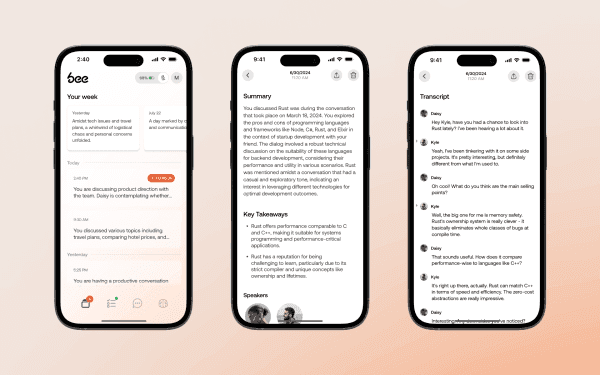
I recently had the opportunity to test out a wearable fromBee, the AI wrist gadget that Amazonacquiredlast year and has sinceupdatedwith a number of new features. Like other AI wearables, Bee is designed as a kind personal assistant: it records, transcribes, and summarizes the user’s conversations throughout the day, providing an ongoing note-taking capability that’s useful if you’re forgetful or just want to be more organized about your life. If you sync it with your calendar, it can also send you alerts and reminders about things you’re supposed to do throughout the day. TechCrunch haswritten about Beebefore, and the way it works is pretty simple: the user powers it up, puts it on, syncs it with the Bee mobile app, and enters some basic personal information. Bee has a built-in recorder that can be turned on and off by clicking the wearable’s button. When Bee is recording, a green light flashes. When it’s not, that green light goes off. After a conversation has been recorded, the app will create an automated summary that is easy to read, as well as an entire transcription of the conversation. Your mileage may vary on how exciting (or not) this whole conceit is. The problem for me is that I am something of a privacy enthusiast. In a world where the average person is beset from all sides by constant digital surveillance, I appreciate any opportunity I can get to not be recorded. Therefore, the idea of walking around with an eavesdropping gizmo strapped to my wrist 24/7 was not particularly appealing. Yet, even I have to admit that — in the right context — Bee could have a lot of potential to help organize your life. Bee really comes through in the context of professional engagements. If your day is full of meetings and you have trouble keeping it all straight, Bee could be a moderately competent assistant. During a business-related phone call this week, I activated Bee after getting confirmation that I could record our meeting. Afterward, the app faithfully regurgitated a summary of the conversation, helpfully breaking down each segment of our talk so that I could review it later without having to re-listen to our entire conversation. This was undeniably helpful, although it should be noted that this isn’t something that’s markedly different than those offered by other transcription services,like OtterorGranolaand others, which also offer transcriptions and auto-generated summaries. That said, you could envision a situation in which a professional who has to navigate between various meetings throughout the day would be well-served by this device. You could just keep Bee running throughout the day and, later, review the conversation summaries for anything you’re not clear about. Bee does a relatively good job at summarizing conversations, but the actual transcripts offered by the wearable can be a bit of a mess. Previous critics have noted that you usually have to manually enter the names of other speakers, as Bee doesn’t always know who is talking. During my conversation, I noticed that it had also omitted certain sections of our chat — nothing huge, but it wasn’t a complete account of everything that had been said. I also took Bee to my semi-weekly movie night with my friends and left it running throughout the night. Given the fact that we watchedReservoir Dogs, I was mildly afraid that the wearable would mistake all of the vulgar carnage for real-life bloodshed and potentially trigger some sort of internal alarm. However, Bee knew — basically — what was happening. The wearable figured out that we were watching a movie and, in the summary of events afterward, the wearable labeled the conversation “Tarantino Film Scene Analysis.” While Bee shows early promise as a professional tool, I would not want this thing recording me in my personal life. Weirdly enough, Bee has largely been marketed as a product for personal use. To be comfortable with that, you have to be comfortable with Bee having access to a majority of both your offline and digital life. Indeed, to work well, Bee needs expansive mobile permissions — including access to your location, photos, phone contacts, calendar, and mobile notifications. You can also share your health data with it — should you, for whatever reason, want it to know about your sleep patterns or your resting heart rate. The large accumulation of data Bee collects is stored in the cloud, which — again, for the digital privacy enthusiast — presents its own concerns. In a message to tech YouTuber Becca Farsace, Bee apparentlyunveiled a demoof the device running entirely locally. Were the company able to produce such a device, I would be thoroughly impressed — and might even consider buying one. That said, Amazon hasn’t offered any update on those plans. As for Bee’sdigital privacy protections, the company says that it offers encryption to protect user data — both at rest and in-transit. In its privacy policy, the company states that it has “implemented technical and organizational security measures designed to protect the security of any personal information” that the company processes. Bee also claims that it undergoes “rigorous third-party security audits” and employs continuous security monitoring. That all sounds quite good, although it’s worth noting that Amazon — like many large tech companies — has been subject to the occasionaldata security issue or two(not exactly surprising for a company that governs as much of the global cloud environment as it does, but still). In short, Bee is a curious piece of hardware that, given some time and some tweaking, could have some promising professional applications further down the road. As a digital assistant for your personal life, however, it might prove to be a little too invasive for some users.
View
A Bionic Arm That Helped India’s Amputees Face The World Again
India has an estimated five lakh upper-limb amputees, according to rehabilitation studies. Access to prosthetics, however, remains sharply unequal.
View

Ferrari is using IBM’s AI to create F1 superfans
Two years ago, IBM realized there was one glaring omission in its roster of sports partnerships: Formula One. Formula One has become one of the world’s most popular sports, especially in the U.S., where Netflix’s “Drive to Survive” documented the working lives of F1 drivers and turned them into mainstream celebrities. The tech-centric sport has also become ahot ticket for tech companieslike AWS, Oracle, and Anthropic, which partner with teams for sponsorship visibility and to provide data analytics and AI tools that can deliver a competitive edge. So when IBM went looking for its next major sports partnership, it’s no wonder the company picked F1 and one of its most iconic teams,Scuderia Ferrari HP. “They’re the winningest team in history,” Kameryn Stanhouse, IBM’s Vice President of Sports and Entertainment Partnerships, told TechCrunch. At the heart of this partnership, however, is what has led other teams to start working with tech giants: access to more sophisticated tech solutions that can help them make the most of, especially, artificial intelligence. In fact, one of the best parts of sports, Stanhouse said, is how much data is available and can be used to help people get comfortable with AI. “They actually see how it serves them,” she said of how AI is used in sports storytelling. The IBM-Ferrari partnership centers on that idea of storytelling, enhancing fan engagement by overhauling the technology powering the Ferrari fan app. To help with this, Ferrari hired Stefano Pallard in the newly titled role “head of fan development,” who said the challenge the team wanted to tackle was not just reaching fans, but “making each of them feel like we know them.” “That starts with taking the data we get from the track and turning it into content that is easy to follow and engaging,” he told TechCrunch. Teamsprocess millions of data pointsper second during each race, capturing every movement of the driver and the car. Turning this into content that fans can engage with is just one way that advanced enterprise AI can help businesses better interact with their consumers. Among the 11 teams, Ferrari is one of the few (alongside the likes of McLaren and Williams) to have a standalone fan app strategy rather than lean on social media or the official F1 platforms instead, showing how the sport is slowly starting to capitalize on its growing global fandom. Some of the changes to the Ferrari app were simple, like offering it in Italian. Even though Ferrari is an Italian company and many of its fans are Italian, their fan app was not available in Italian until the IBM partnership. Stanhouse said the old Ferrari fan app was a place where people went to find race details and then leave. This new app has games where fans can play with others in the app, new AI-written race summaries, more behind-the-scenes stories about the team and the drivers, a place to make predictions, and an AI companion for fans to ask questions. “There are two drivers, but did you know it takes 24 people working simultaneously in two seconds to change a tire?” Stanhouse said, adding that storytelling helps fans feel closer to the team. Unlike other sports apps IBM has built, Stanhouse said the Ferrari app’s main focus is storytelling because it wants fans to stay engaged with it all year long, rather than for a few weeks a year, as with tournaments like the Masters. Engagement data for the app has been trending upward since IBM came into the scene, Stanhouse said, citing a 62% increase in engagement over race weekends as an example. Pallard said the team then uses AI to analyze engagement signals in the app, such as which content people like to read and the sentiment of the messages fans send. “That helps us understand what resonates most with the Tifosi [the fan nickname for Ferrari] and it directly informs how we shape our storytelling and how we deliver content,” he said. The team hopes to dive deeper into personalization and create more immersive fan experiences. The app developers also took into account Ferrari’s fanbase, which is much more diverse than it was even five years ago. F1 releasedstats last year showingthat 75% of new fans were women, many of whom were Gen Z. A particular draw for women is the F1 Academy, an all-female racing series that aims to develop the next generation of women drivers. But these new fans, much like the old, are after one thing — more. “They are asking for more data, more insight, more features, and we have to be able to deliver that,” Pallard said. “With IBM, the vision for the next five years is to make every fan feel like the experience was built for them, whether they have been with us for 30 years or 30 days. That is how you build loyalty that lasts.”
View